
SignTeam Production Notes
Why Cheap Truck Lettering Cracks in Two Years: Cast vs Calendered Vinyl
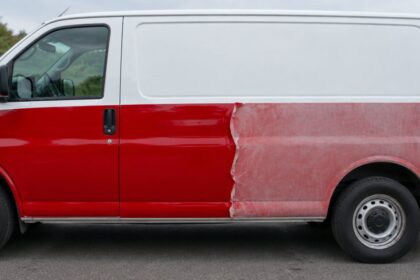
Two truck lettering jobs can look identical the day they are installed and look nothing alike three years later. One still has crisp edges. The other has hairline cracks tracing every letter, curling corners, and a gray outline of adhesive creeping past the vinyl. The difference usually is not the installer and it is not the design. It is a material decision that was made before the printer ever ran: cast or calendered vinyl.
This is the single most consequential choice in vehicle graphics, and most buyers have never heard of it. Here is the honest version.
/The difference is how the film is born
Cast vinyl starts as a liquid. It is poured onto a casting sheet and cured, so the film ends up thin, soft, and completely relaxed. It has no memory of being any other shape, which means it does not fight you. It conforms to curves, rivets, and corrugations, stays where it is put, and is rated for 7 to 10 years outdoors.
Calendered vinyl is made the opposite way: a hot mass of PVC squeezed through steel rollers, like pasta through a machine. Squeezing is stretching, and the film never forgets it. For the rest of its life, calendered vinyl wants to shrink back toward the shape it was rolled from. It is thicker, stiffer, cheaper, and rated 3 to 6 years on flat surfaces only.
That shrink memory is the villain in the cracked lettering story. As calendered vinyl shrinks over months and years, the exposed adhesive edge collects dirt and shows as an outline around every letter. On curves and rivets, the shrinking film literally pulls itself up and off. And as the film ages and stiffens, the tension shows up as hairline cracking at the stress points, which on lettering means everywhere.
/Where each one belongs
Calendered vinyl is not a scam and cast is not always the answer. Honest shops stock both and match the film to the job.
Calendered is the right call for flat signs, window graphics, short term promotions, coroplast and ACM decals, and event graphics that come down in a season or two. On a dead flat surface with a defined lifespan, paying for cast is burning money, and we will tell you that.
Cast is the right call for anything on a vehicle that is not perfectly flat, any graphic expected to live past roughly 5 years, and any job you want a manufacturer warranty behind. Vehicle warranties from the film makers specifically require cast films on curved and riveted surfaces; put calendered vinyl on a rivet and the warranty is void before the truck leaves the lot.
The gray zone is flat fleet surfaces: box trucks, trailers, flat door panels. Intermediate calendered films can run for years there, and for a trailer that gets replaced on a schedule that can be a smart economy. The known tradeoffs: expect edge cracking sooner, expect failure on hoods because engine heat accelerates everything, and expect no warranty coverage if any of it wraps a curve.
/The money math buyers get wrong
Here is what makes this decision easy: the vinyl is a small fraction of a vehicle job. Between printing, laminating, and installation labor, upgrading the film from calendered to cast typically moves the total price by a few percent. Cracked lettering two years in does not just cost a reprint; it costs a second install, plus removal.
And removal is the hidden invoice. Aged calendered vinyl comes off in confetti sized chips, each one fighting, with adhesive left behind. Aged cast peels in satisfying strips. Shops quote removal by the hour for exactly this reason, and the difference between removing a 7 year old cast job and a 7 year old calendered job on the same truck can be several hours of labor. The cheap film gets you twice: once when it fails early and again when it fights removal.
/How to order the right thing
You do not need to memorize film part numbers. Answer three questions and the material picks itself: Is the surface flat or does it have curves, rivets, or corrugation? How many years should this graphic live? Does the job need a warranty behind it?
Flat, short term, no warranty pressure: calendered, and keep the savings. Curved or long term or warrantied: cast, laminated, no exceptions worth making. If a quote for vehicle graphics is dramatically cheaper than the others, ask which film it uses before celebrating. That is usually where the difference lives.
More on this in the vehicle graphics section of our FAQ. SignTeam is a wholesale trade printer serving sign shops and resellers: we print on both cast and calendered films and will tell you straight which one your job actually needs. Browse wholesale vinyl and decal pricing or call 563.296.8386.