
SignTeam Production Notes
Wind Slits Are a Myth: What Actually Keeps a Banner Alive in Wind
Every week someone asks us to cut wind slits into a banner. Our answer is always the same: no, and here is why we will talk you out of it every single time.
Wind slits are one of the most persistent myths in the sign industry. The idea sounds reasonable. Cut some half moon flaps into the banner, wind passes through, banner survives. The problem is that the physics does not work, the field results do not back it up, and the slits themselves become the reason the banner dies.
/The math on wind slits is brutal
An engineering analysis published in SignCraft magazine looked at what slits actually accomplish. Four 6 inch slits, a typical setup, relieve about one square foot of wind load. On a 3×10 banner, that is one square foot of relief on a 30 square foot sail. Roughly 3 percent. The wind does not care.
What the slits do accomplish is structural damage. Every cut in vinyl is a tear starting point. Vinyl banner material is strong in sheet form and weak once a cut concentrates stress at a single point, the same way a small nick in packing tape lets you rip the whole strip. Go look at torn banners in the wild. They almost never fail in the middle of an intact panel, and they almost never fail at a properly welded hem. They rip from a slit, a hole, or a poorly reinforced corner, and the tear runs from there.
So the standard trade is this: you give up a few percent of wind load in exchange for a dozen pre-installed failure points. That is a bad trade at any price.
/What actually kills banners
After enough warranty conversations, you learn that wind rarely kills a banner on its own. Three things do.
Movement. A banner mounted drum tight has to fight the wind as a unit, and vinyl is good at that. A banner with slack flaps thousands of times a day, and every flap is a fatigue cycle on the material and a shock load on the mounting points. The banners that last are the ones that cannot move. The ones that die young are the ones installed loose, on stretchy rope, or zip tied at only the four corners.
Mounting points. Roughly 90 percent of banner failures happen where the banner attaches to the structure, not in the material. Four corner grommets on a 10 foot banner means each grommet carries a quarter of the entire wind load, and the corners get sawed back and forth with every gust. Spreading that load is the whole game.
Sun plus time. UV slowly embrittles vinyl. A two year old banner tears easier than a new one, which is why an old banner that survived two winters suddenly shreds in a storm that a new banner would have shrugged off. Banners are temporary signage. Plan on 1 to 3 years outdoors and treat anything beyond that as a bonus.
/What to do instead of slits
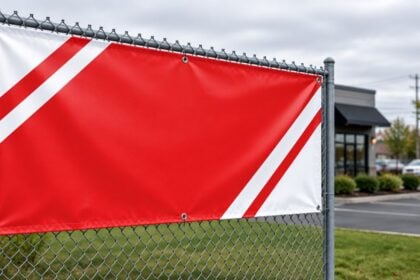
Order mesh if wind is the defining problem. Mesh banner material lets roughly 30 to 40 percent of the air pass through the weave itself, across the entire surface, which is what people imagine slits are doing. It is the correct engineering answer for fence lines, construction sites, sports field fencing, and anything exposed on an open lot. The honest tradeoff: colors print slightly less dense on mesh, and it is not magic either. A badly installed mesh banner still fails at the mounting points.
Get the finishing right. At SignTeam every banner hem is heat welded, not sewn and not taped. Welding fuses the folded edge into a single piece of material, so there is no stitching to rot in the sun and no tape adhesive to let go in summer heat. Standard grommets go every 2 to 3 feet around the perimeter. For high wind installs we offer grommets every 12 inches, and that is the single cheapest upgrade you can make on a banner going somewhere windy. More attachment points means each one carries less load, and the difference in survival is dramatic.
Install it tight and attach the whole perimeter. Use every grommet, not just the corners. On fences, run zip ties or bungees through all of them and pull the banner flat. Bungee cords at the corners are useful on frames because they give a little before the vinyl has to. If you use zip ties, think of them as the fuse in the circuit: sized right, the tie snaps in a catastrophic gust before the banner or the fence fails, and replacing zip ties is free compared to replacing banners.
Size the banner honestly. A 4×20 banner on an open fence line in a windy region is going to have a hard life no matter what anyone does. Sometimes the right answer is two smaller banners, a mesh version, or a rigid sign. If you need something up for 5 or more years, you want an ACM sign, not any banner.
/The conversation we have with buyers
When a customer insists on wind slits, we explain the math, and then we ask what problem they are actually trying to solve. Almost always the real story is a previous banner that tore, and almost always the autopsy points at the install: corner-only attachment, slack material, or a banner that stayed up three years past its design life. Slits would not have saved it. Better finishing and a tighter install would have.
That is also why we do not sell wind slits as an option. Cutting failure points into a banner we welded and grommeted correctly makes the product worse, and we would rather lose the upsell than warranty the tear.
/The short version
Wind slits relieve almost no wind load and create tear points, so skip them. Order 13oz vinyl with heat welded hems for most jobs, 18oz for oversized or long term banners, and mesh when wind rules the site. Put grommets every 2 to 3 feet, or every 12 inches for windy locations. Install drum tight using every grommet, and replace banners on schedule instead of running them until the sun makes them brittle.
Have a wind question about a specific install? Check the banner section of our FAQ or call us at 563.296.8386. SignTeam is a wholesale trade printer, so if you are a sign shop or reseller, browse wholesale banner pricing here. We print, you get the credit.